Every year, production managers make a costly mistake — they buy the wrong machine for their compound. One wrong call can cost you batch consistency, cycle time, and ultimately, customers.
If you’re trying to decide between a rubber mixing mill and a dispersion kneader, you’re not alone. It’s the most common question we hear from factory owners and procurement heads — and it’s the one that deserves a straight, honest answer.
This guide will give you exactly that.
Why This Decision Matters More Than You Think
The rubber compounding process is the foundation of every downstream product — seals, gaskets, tires, hoses, footwear. Get the mixing wrong, and nothing that follows will fix it.
A poorly chosen machine leads to:
- Uneven dispersion of carbon black, fillers, and curatives
- Excessive heat buildup, burning your compound before vulcanization
- Inconsistent batch-to-batch quality, killing your client relationships
- Wasted raw material and higher production costs per kg
The choice between an open two-roll mixing mill and a closed dispersion kneader affects all of this. And the right answer depends entirely on your compound, your volume, and your output requirements.
Understanding the Two Machines — No Jargon
What Is a Rubber Mixing Mill?
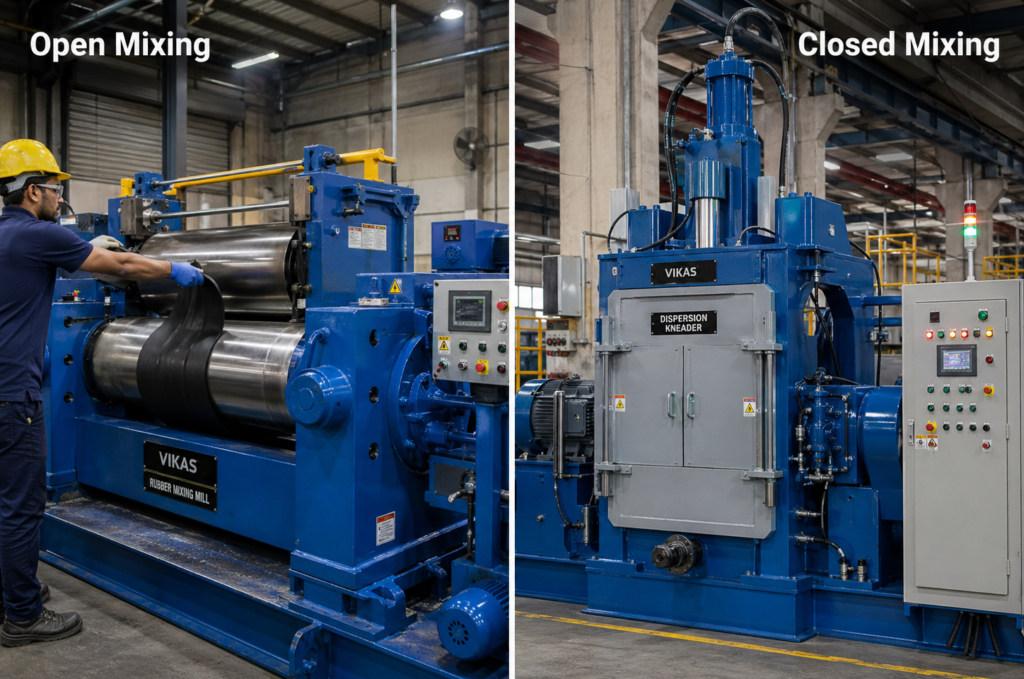
A rubber mixing mill (also called a two-roll mill or open mill) uses two counter-rotating horizontal rolls to masticate and blend rubber with compounding ingredients. The operator manually feeds and folds the rubber band over the rolls.
Key characteristics:
- Open operation — operator visible control
- Suitable for small-to-medium batch sizes
- Excellent for colour compounding and specialty batches
- Requires skilled operator intervention
- Lower capital cost
- Ideal for natural rubber, SBR, EPDM compounds
Explore Vikas Industries’ Rubber Mixing Mill range
What Is a Dispersion Kneader?
A dispersion kneader (also known as an internal mixer or banbury-style mixer) is a closed mixing system. Rubber and ingredients are loaded into an enclosed chamber where a rotor blends them under controlled temperature and pressure.
Key characteristics:
- Closed, dust-free mixing environment
- Higher throughput and consistent batch quality
- Better temperature control via jacketed chambers
- Ideal for high-volume, high-precision compounding
- Works well with NBR, silicone, and highly filled compounds
- Lower dependency on operator skill
Explore Vikas Industries’ Dispersion Kneader range
Research published on ScienceDirect on internal mixer dispersion mixing confirms that internal mixers deliver significantly better filler dispersion homogeneity compared to open mills — a critical factor for high-performance technical compounds.
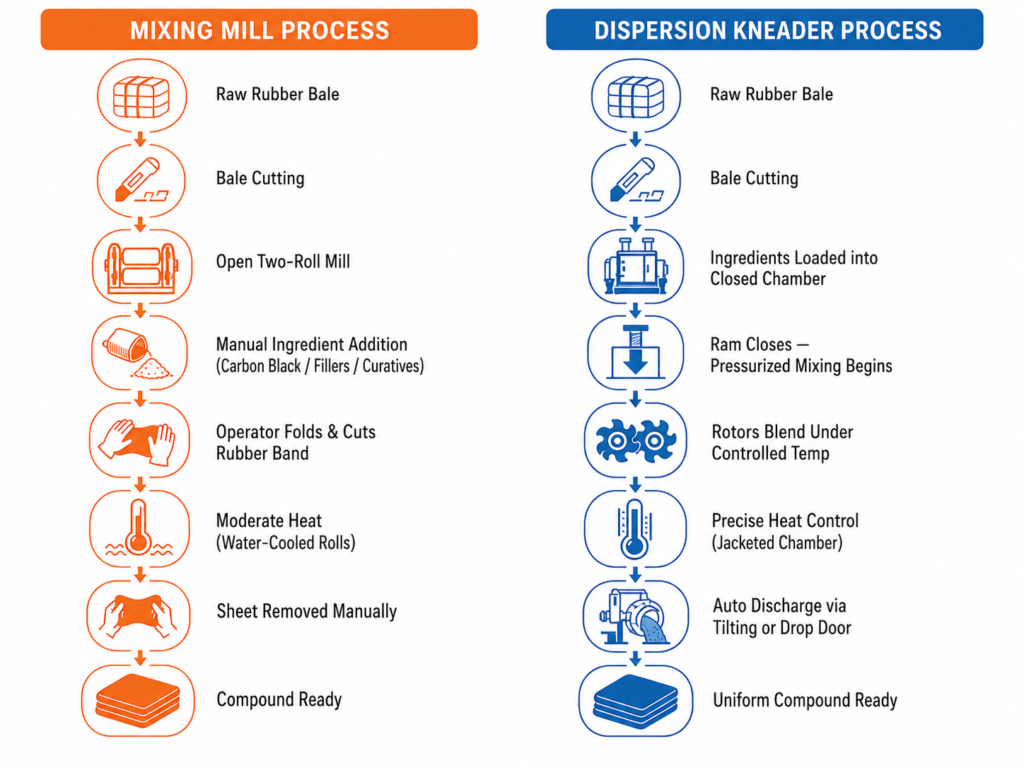
Head-to-Head Comparison — The Numbers That Matter
| Parameter | Rubber Mixing Mill | Dispersion Kneader |
|---|---|---|
| Batch Size | 5 – 50 kg | 20 – 270 kg |
| Mixing Type | Open / Visible | Closed / Internal |
| Temperature Control | Moderate (water-cooled rolls) | High (jacketed chamber) |
| Operator Dependency | High | Low |
| Filler Dispersion | Good | Excellent |
| Dust / Fumes | Exposed | Enclosed |
| Capital Cost | Lower | Higher |
| Energy Efficiency | Good | Better at scale |
| Best For | Specialty, colour, R&D | Mass production, precision |
Key Benefits — Choosing the Right Machine Pays for Itself
Why a Mixing Mill Might Be Your Right Call
- Lower entry cost — ideal for mid-size manufacturers not running 3-shift operations
- Flexibility — switch compounds quickly with minimal cleaning downtime
- Transparency — operator can see and feel the compound, adjust in real-time
- R&D-friendly — perfect for developing new formulations in small batches
- Easier maintenance — fewer enclosed parts, accessible nip rolls
Why a Dispersion Kneader Wins for Serious Volume
- Consistent batch quality — removes human variability from mixing
- Better dispersion — especially for carbon black, silica, and high-loading fillers
- Safer operations — enclosed chamber means no chemical dust exposure
- Higher throughput — more kg per hour with less operator involvement
- Compound integrity — controlled heat prevents premature scorch
Real Industry Applications — What We See in the Field
Use a Mixing Mill when:
- You manufacture rubber footwear or coloured consumer rubber goods
- Your batch sizes are small and formulations change frequently
- You’re running a laboratory or R&D compounding unit
- You work with natural rubber and standard elastomers
Use a Dispersion Kneader when:
- You produce automotive seals, gaskets, or technical rubber components
- Your compound uses carbon black, silica, or high-dose fillers
- You need batch-to-batch certification for quality-critical applications
- You’re scaling production and need to reduce operator dependency
- You handle NBR, HNBR, fluoroelastomers, or highly-filled silicone compounds
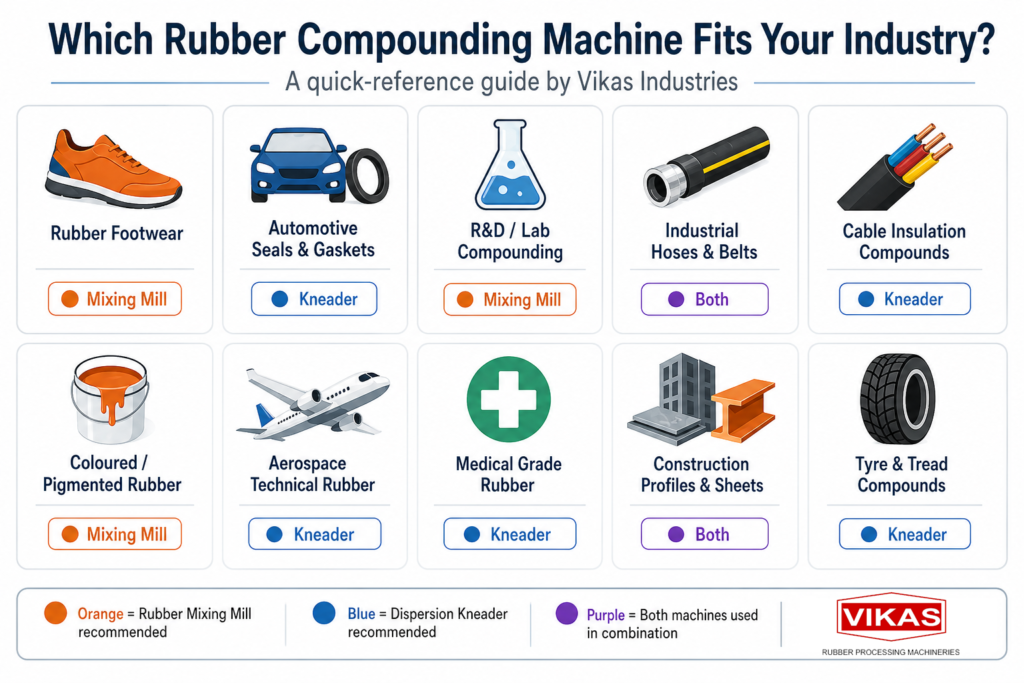
How Vikas Industries Solves This — Built for Indian and Global Manufacturers
At Vikas Industries, we’ve been manufacturing rubber processing machinery for decades — and we’ve supplied equipment to plants across India, Southeast Asia, and the Middle East. We understand that your production floor has its own challenges, constraints, and growth targets.
That’s why we don’t just sell machines. We help you configure the right equipment for your specific compound profile and production volume.
Our rubber processing machinery range includes:
- Rubber Mixing Mill — Heavy-duty two-roll mills with precision roll gap control, friction ratio setting, and variable speed drives for your compounding requirements
- Dispersion Kneader — Tangential and intermeshing rotor kneaders with temperature-controlled jacketed chambers and programmable mixing cycles
- Rubber Bale Cutter — For efficient raw rubber preparation before mixing
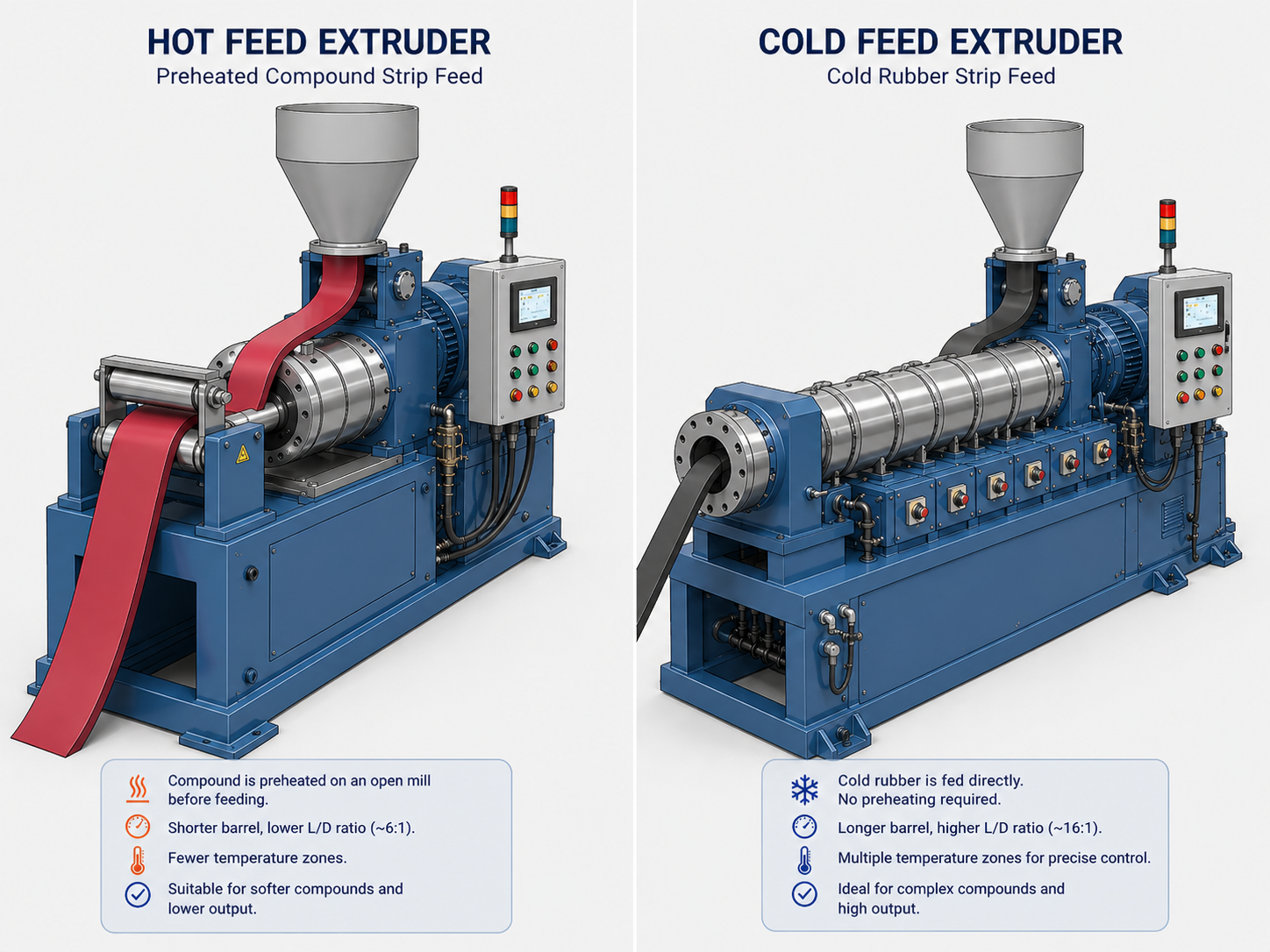
- Hot Feed & Cold Feed Extruder — For downstream shaping after compounding
- Rubber Hydraulic Press — For vulcanization and finished product manufacturing
Every machine is engineered for durability, minimal maintenance downtime, and Indian operating conditions — because we know what 45°C shop floors, voltage fluctuations, and three-shift operations actually demand.
What’s Changing in Rubber Compounding — Future Trends to Watch
The rubber industry is not standing still. Here’s what forward-thinking production managers are already preparing for:
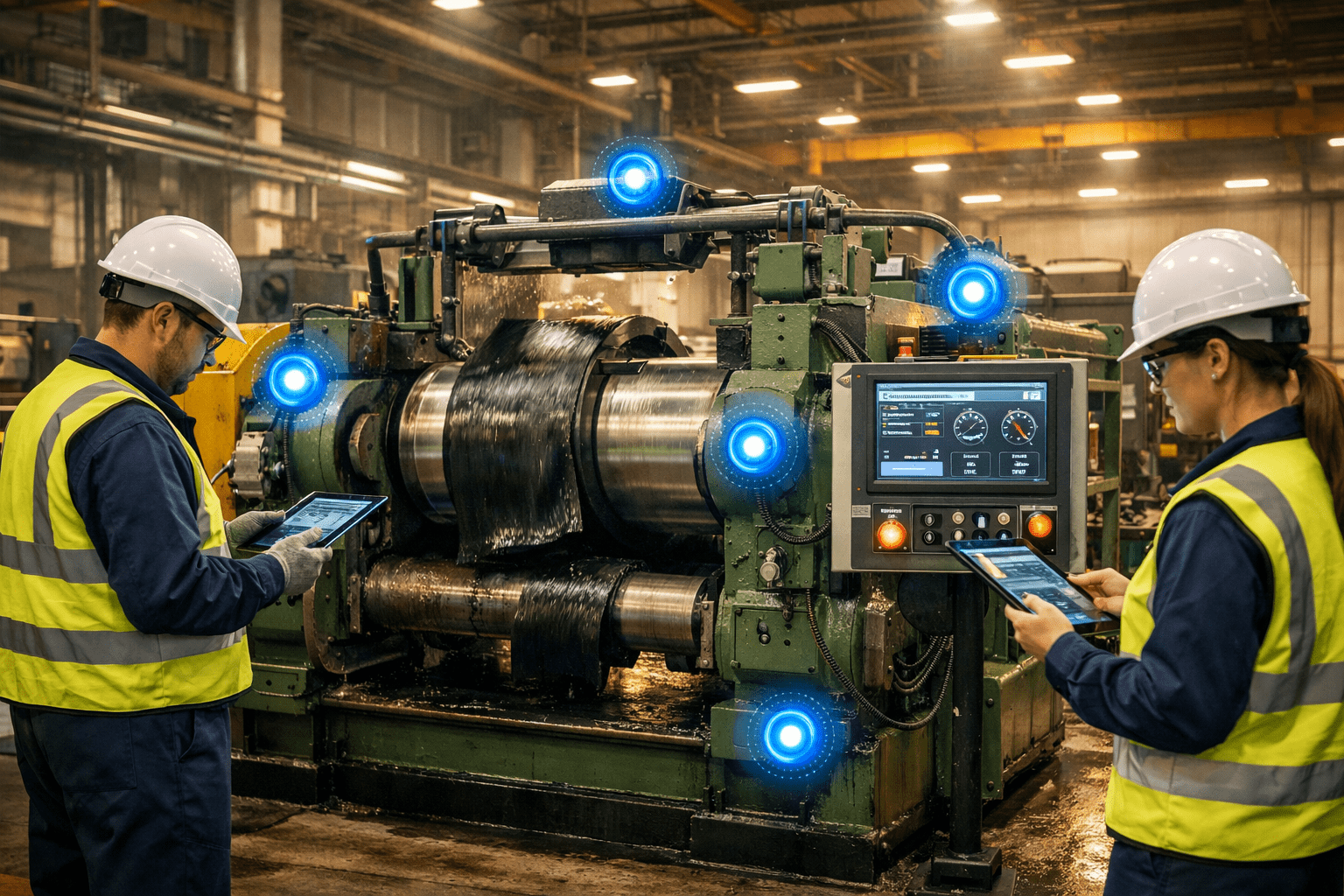
1. Automation and PLC Integration More plants are moving toward PLC-controlled kneaders with recipe management systems — reducing batch variability and enabling traceable quality records.
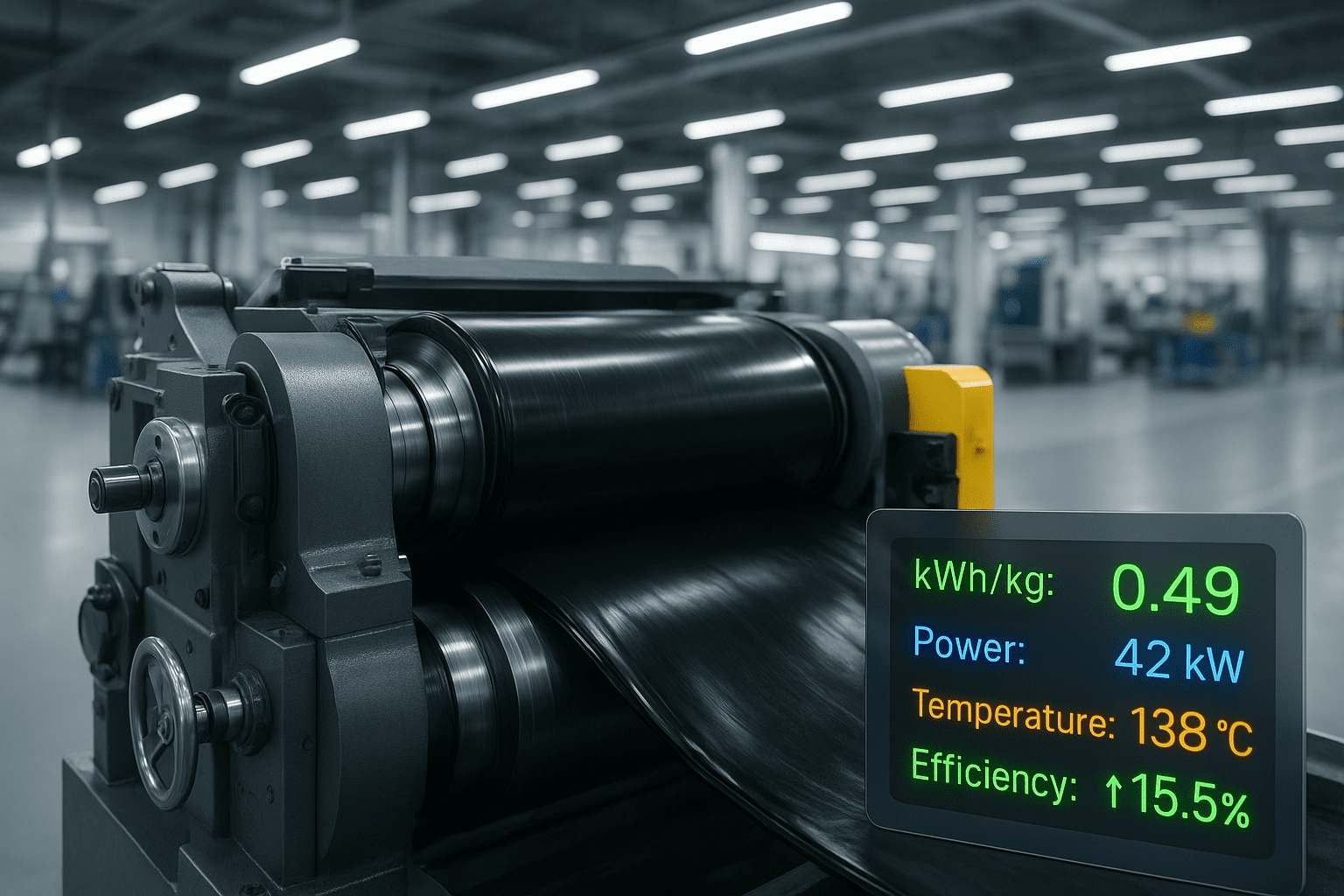
2. Energy Monitoring With power costs rising, energy-efficient drive systems on both mills and kneaders are becoming a purchasing priority. Look for machines with variable frequency drives (VFDs).
3. Dust and Emission Control Occupational safety standards are tightening globally. Enclosed mixing (kneaders) and proper dust extraction on open mills will become mandatory, not optional.
4. Silica-Based Compounding The global shift from carbon black to precipitated silica (especially in the tyre industry) demands internal mixers with precise temperature control — a further advantage for dispersion kneaders.
Expert insight: The right compounding equipment chosen today should be sized not just for your current production — but for where you plan to be in 5 years.
Stop Guessing, Start Calculating
The choice between a rubber mixing mill and a dispersion kneader isn’t about which machine is “better.” It’s about which one is right for your compound, your volume, and your growth plan.
- If you’re running specialty batches, colours, or R&D: Start with a Mixing Mill.
- If you’re scaling production, handling technical compounds, or need batch consistency: Invest in a Dispersion Kneader.
- If you’re running a full production line: You’ll likely need both — and that’s exactly what Vikas Industries is built to supply.
Don’t let the wrong equipment decision cost you production efficiency, compound quality, or customer trust.
Talk to a Machine Expert Before You Decide
Ready to configure the right rubber compounding machinery for your plant?
The Vikas Industries team has helped hundreds of manufacturers — from small compounding units to large-scale automotive suppliers — choose, install, and commission the right equipment.
🔵 Get a Free Equipment Consultation
🔵 Explore Our Full Rubber Machinery Range
📞 Call us directly or Request a Quote — our technical team will assess your compound requirements and recommend the right machine configuration, no sales pitch, no fluff.
About Vikas Industries Vikas Industries is a leading manufacturer of rubber processing machinery including Rubber Mixing Mills, Dispersion Kneaders, Rubber Hydraulic Presses, Bale Cutters, and Extruders. Trusted by rubber manufacturers across India and globally. 🌐 www.vikasindustriesmachinery.com